In Mains, knowledge matters, but your ability to present that knowledge matters just as much. Two aspirants can read the same books and score very differently because one of them writes clear, structured, time-bound answers and the other does not. The good news is that this skill is built by routine, not by talent.
This article gives you a simple 45-minute daily answer-writing routine, a checklist to evaluate your own answers, and a way to turn every day’s writing into measurable improvement.
Know the format you are training for
General Studies papers in UPSC Mains carry 250 marks in 3 hours, with 10-mark questions (around 150 words) and 15-mark questions (around 250 words). That works out to roughly 7 minutes for a 10-marker and 11 minutes for a 15-marker, including thinking time. If you practise without a timer, you are training for a different exam.
The practice loop: Write, Evaluate, Identify gaps, Improve
Daily practice only works when it is a loop and not just a writing habit. Each step feeds the next:
- Write the answer under the time limit, by hand.
- Evaluate it against a fixed checklist (given below) or through expert review.
- Identify gaps – was the problem content, structure, time or presentation?
- Improve by rewriting the weakest part and noting the lesson for next time.
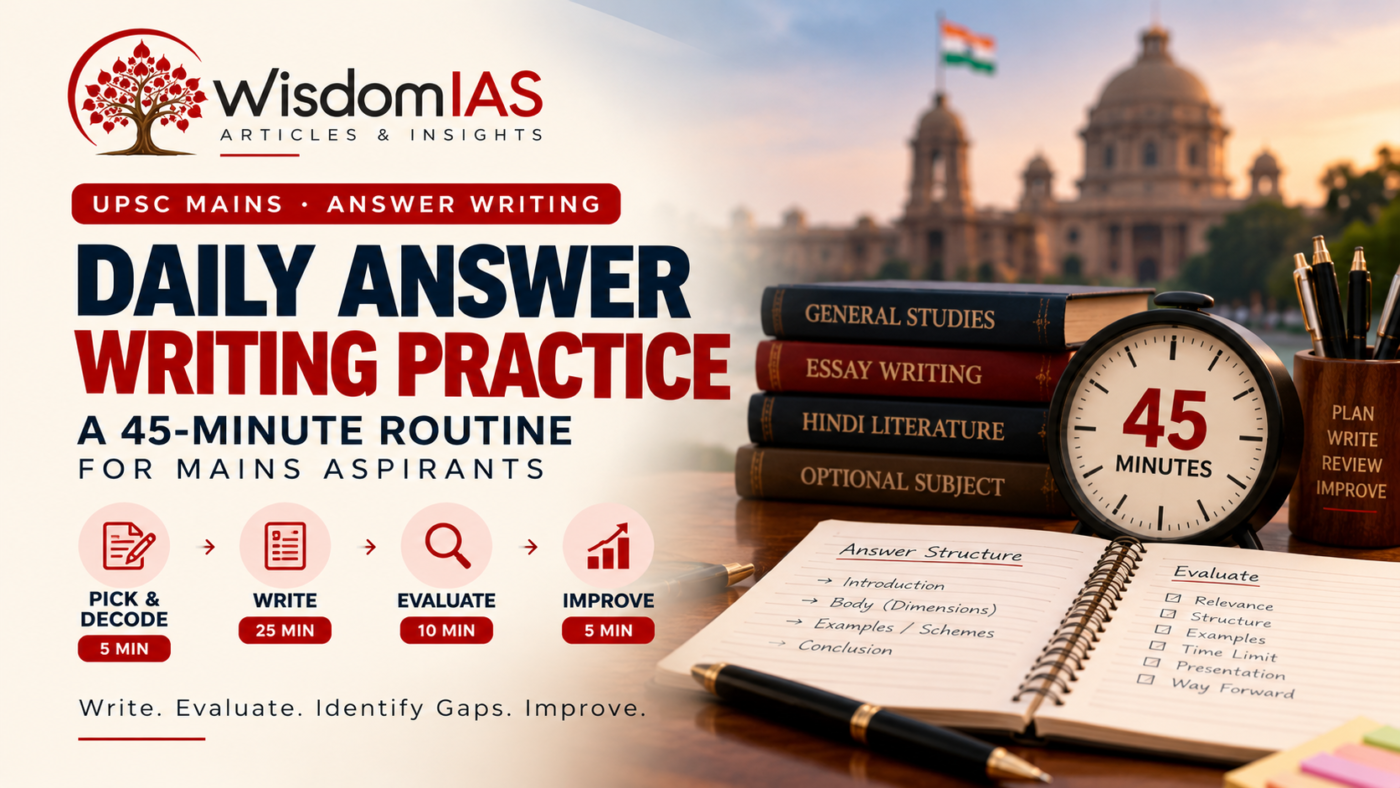
A 45-minute daily routine
| Step | Time | What to do |
|---|---|---|
| Pick and decode questions | 5 min | Choose 3 questions; underline the directive word and the demand |
| Write | 25 min | Two 10-markers (7 min each) and one 15-marker (11 min) |
| Evaluate | 10 min | Use the checklist; mark what is missing or weak |
| Improve | 5 min | Rewrite one introduction or conclusion and log the lesson |
Consistency beats intensity. Forty-five focused minutes every day will take you further than a five-hour session once a fortnight.
Anatomy of a good Mains answer
Introduction (2–3 lines)
Define the key term, give brief context, or use a relevant fact. Do not restate the question. Move to the core of the demand quickly.
Body (the scoring part)
Break the answer into dimensions and use short paragraphs or crisp points with headings where they help. Support each point with an example, a scheme, a case, a committee or a data point. Keep one idea per paragraph so that the examiner can find your points at a glance.
Conclusion (2–3 lines)
Close with a balanced way forward or a constructive, forward-looking line. A conclusion that connects back to the question tells the examiner your answer is complete.
Respect the directive word
The verb in the question decides the shape of your answer. “Discuss” asks for a broad treatment, “critically examine” asks for strengths and weaknesses, “analyse” asks you to break the issue into parts and show relationships, and “evaluate” asks for a judgement backed by reasons. A well-written answer that ignores the directive word loses marks.
A quick self-evaluation checklist
- Did I answer exactly what was asked, including every part of the question?
- Is the introduction short and relevant?
- Did I cover at least three or four dimensions?
- Did I use examples, data, schemes or cases?
- Is the structure visible, with short paragraphs or headings?
- Did I finish within the time limit?
- Is my handwriting readable and the page well organised?
- Does my conclusion add something instead of repeating?
Mistakes that quietly cost marks
- Copying from notes and calling it practice.
- Practising without a timer.
- Writing and never reviewing.
- Waiting until the syllabus is “complete” before starting.
- Choosing only your strong topics and avoiding weak ones.
- Repeating the same structural error for weeks because nobody pointed it out.
Track your errors, not just your answers
Keep a small log with three columns: question type, main weakness and fix. After two weeks, patterns will appear. Perhaps your introductions are too long, or you run out of time on 15-markers. Fixing one pattern at a time is far more effective than trying to improve everything at once.
Write every day. Improve every answer.
WisdomIAS
Rotate papers, essays and optional
Spread your daily practice across General Studies papers, an essay outline, and your optional subject (for example, Hindi Literature) so that no area is left untested. Most aspirants find a weekly rotation easier to follow than deciding every morning.
The WisdomIAS Daily Answer Writing Practice programme is built on this same loop: regular writing across GS, essay and Hindi Literature, followed by detailed evaluation so that each day’s answer teaches you something specific.