State PSC examinations such as BPSC and UPPSC have their own patterns, their own syllabus emphasis and their own regional flavour. Yet the habits that earn marks in the Mains are surprisingly similar to those that work in UPSC: clear structure, relevant examples and disciplined time use. The difference lies in how you add state-specific content to that common frame. (Pattern, marks, word limits and syllabus change from time to time, so always rely on the latest official notification of the commission.)
This guide gives BPSC and UPPSC aspirants a practical plan: how to read the syllabus, how to blend national and state content, how to write answers and essays, and how to practise in a regular rhythm.
Start with the official syllabus and past papers
Print the syllabus for each paper and mark every topic against your preparation level: strong, average or weak. Then read the questions of the last few years for the same paper. You will see how much weight goes to national topics, how much to state-specific topics, and how the questions are worded. This one exercise saves months of unfocused reading.
Blend the national frame with state-specific content
A strong state PSC answer often links a national idea to a local reality. For example, a question on agriculture, flood management, education, migration or industrial growth can be answered with a general framework and then grounded with a state-level scheme, a regional case or a local data point. Keep a short notebook for each theme with two columns: the national angle and the state angle.
| Theme | National angle | State angle to add |
|---|---|---|
| Agriculture | Policy, reforms, institutions | Regional crops, state schemes, local challenges |
| Social sector | Constitutional provisions, central programmes | State initiatives, local social issues |
| Economy | Growth and policy trends | State economic profile and priorities |
| Environment and disaster | National frameworks | State-specific risks and responses |
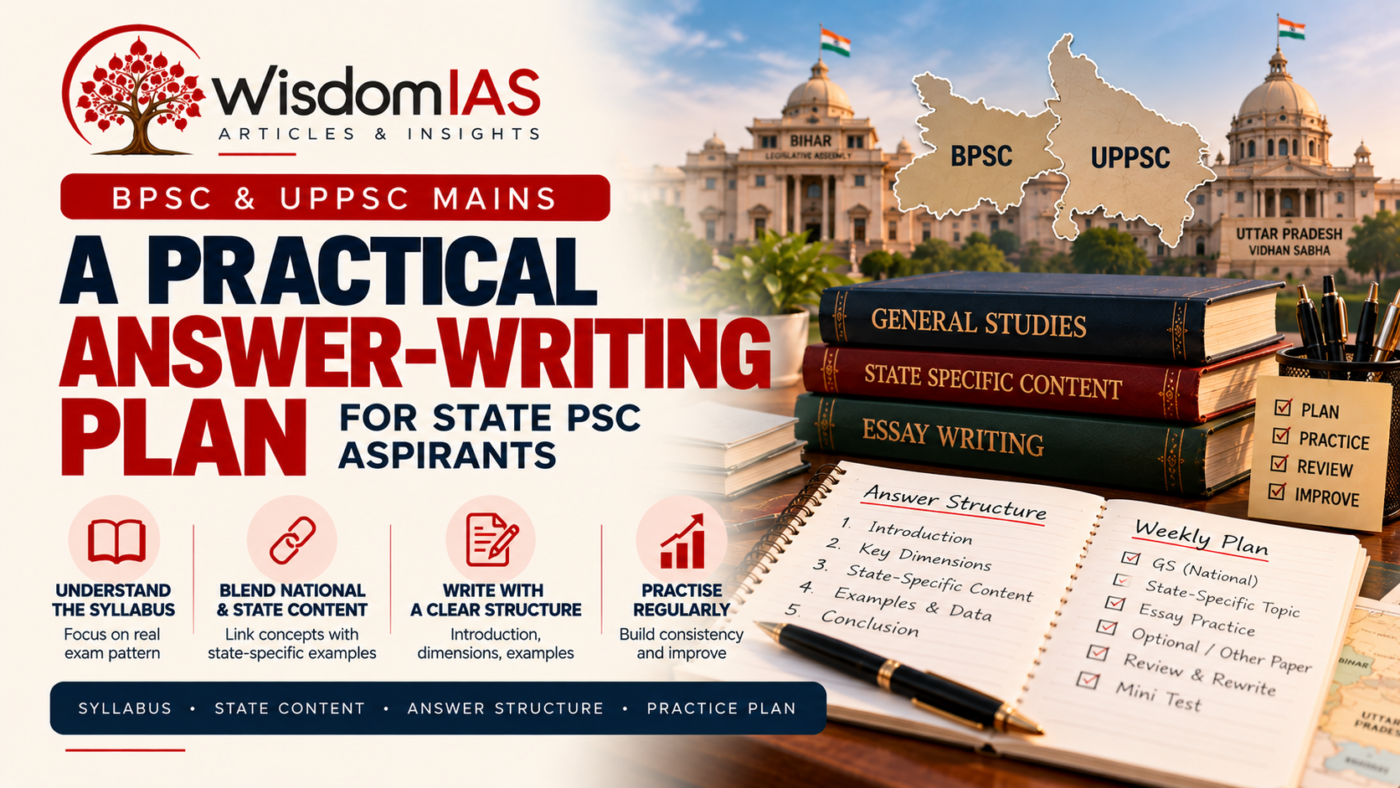
A simple answer structure that works
- Introduction: two or three lines with a definition, context or relevant fact.
- Body: three or four dimensions, each with a short heading or paragraph and one example.
- State link: a line or two connecting the answer to the state wherever the question allows.
- Conclusion: a balanced, forward-looking close.
Whatever the word limit and number of questions in your paper, divide your time per question before the exam and practise to that limit. Many State PSC aspirants lose marks not because they do not know the answer, but because they cannot finish the paper.
Essay and language papers
If your paper includes an essay, use the same approach as in UPSC: decode the topic, plan four or five dimensions, and write with a clear introduction, body and conclusion. Add state-level examples where they fit naturally. If your papers include Hindi language or other qualifying components, practise them regularly as well, since a lapse there can undo good work elsewhere.
A balanced weekly rhythm
| Day | Focus | Output |
|---|---|---|
| Day 1 | GS paper with national topics | 3 timed answers |
| Day 2 | State-specific topic | 2 timed answers with state examples |
| Day 3 | Essay planning | One topic decoded, outline written |
| Day 4 | Optional or another paper | 3 timed answers |
| Day 5 | Review | Self-evaluation, rewrite of one weak answer |
| Weekend | Mini-test and revision | Mixed set under exam conditions plus notes update |
Mistakes State PSC aspirants should avoid
- Preparing only national topics and ignoring state-specific content, or the reverse.
- Copying the UPSC pattern blindly without checking the commission’s notification.
- Reading many sources but never writing under a timer.
- Using outdated data about the state’s schemes and statistics.
- Leaving the last questions unattempted for lack of time.
- Not getting any answer evaluated by an experienced reviewer.
Write every day. Improve every answer.
WisdomIAS
Turn practice into progress
Whether you are preparing for BPSC or UPPSC, the cycle remains the same: write, evaluate, find your gaps and improve. WisdomIAS supports State PSC aspirants through Daily Answer Writing Practice, essay training and test-based evaluation, with feedback that is specific to your writing.