Philosophical topics frighten many aspirants. Statements such as “Wisdom lies in knowing what not to pursue” or “Freedom is not the absence of restraint” have no facts to recall and no scheme to cite. The fear is natural, but it is also misplaced. A philosophical essay does not need philosophy as a subject. It needs clear thinking, a structured argument and well-chosen examples.
This guide gives you a step-by-step method to handle abstract topics calmly and write an essay that is both thoughtful and grounded.
Why philosophical topics are risky and rewarding
Philosophical topics are risky because it is easy to drift into vague, repetitive and over-quoted writing. They are rewarding because the examiner sees real thinking. If your essay stays grounded and organised, it stands out in a stack of fact-heavy essays on contemporary topics.
Step 1: Unpack the statement
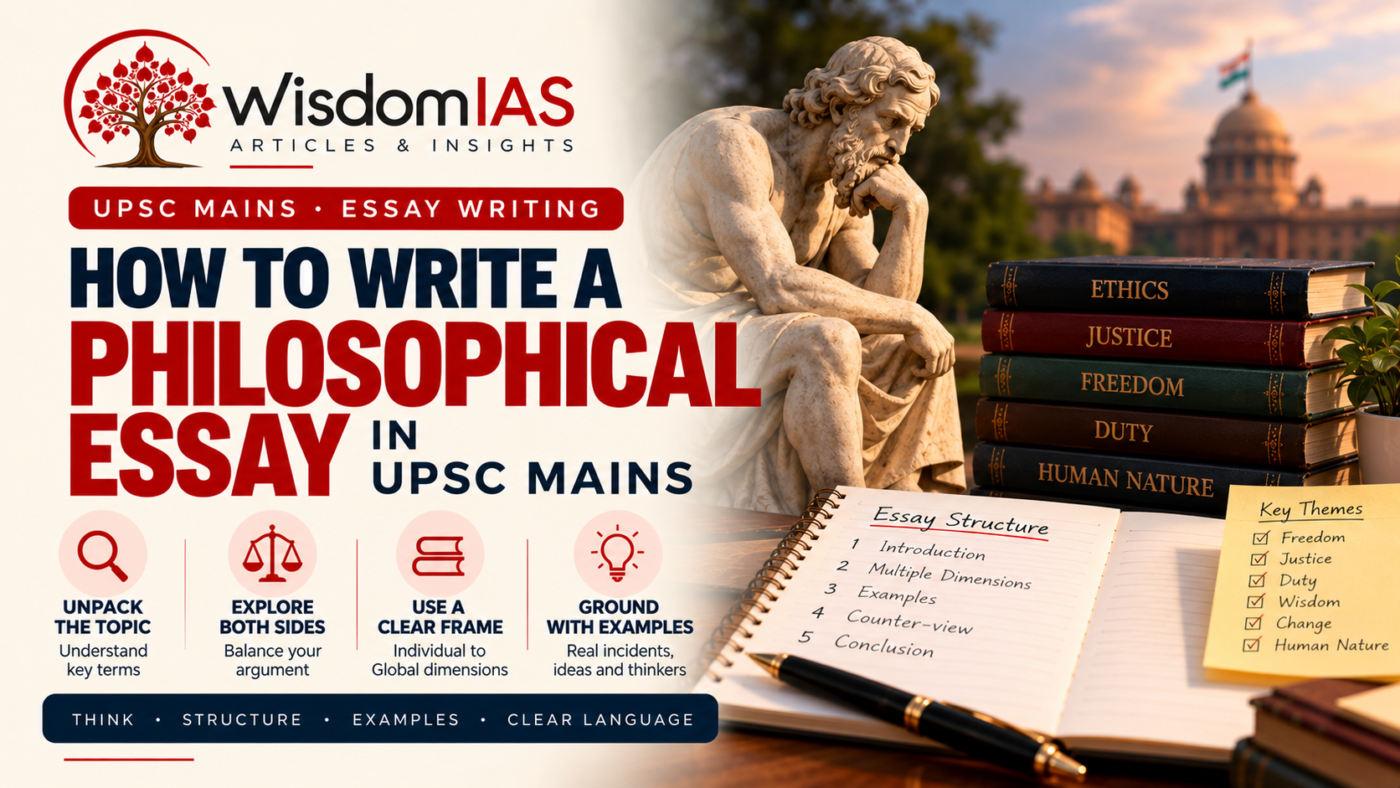
Break the topic into its key terms and ask what each one means. Then ask what the statement as a whole is claiming. Take an illustrative topic such as “Freedom is not the absence of restraint.”
- Freedom: political, social, economic and inner freedom.
- Restraint: law, ethics, duty, self-discipline.
- Claim: real freedom needs a sense of limits, so restraint can enable freedom instead of ending it.
Step 2: Test the statement from both sides
Ask when the statement is true, and when it is not. A good philosophical essay does not simply agree with the topic. It shows where the idea holds, where it needs qualification and what a balanced position looks like. This gives your essay depth and protects it from sounding one-sided.
Step 3: Use the ladder of dimensions
Move from the individual to the global in steps. This gives the essay a natural order and prevents repetition.
| Level | Question to ask | Type of example |
|---|---|---|
| Individual | How does this idea show up in a person’s choices and character? | A life story, a habit, a decision |
| Society | How does it shape relations, culture and institutions? | A social movement, a custom |
| State and governance | How do law and policy reflect this idea? | A constitutional provision, a policy debate |
| Global | How does it matter between nations and for humanity? | An international issue or agreement |
Step 4: Ground every idea with an example
An abstract paragraph without an example floats in the air. Pair each idea with a real incident, a historical episode, a leader’s life, a literary reference or a constitutional principle. Keep a notebook of such examples sorted by theme, for instance justice, freedom, duty, wisdom, courage and change. A few strong examples can serve many essays.
Step 5: Write with a clear thread
- Introduction: a short, real hook, the meaning of the key terms and a thesis in a sentence or two.
- Body: one dimension per paragraph, each moving from claim to explanation to example, ending with a link to the next idea.
- Counter-view: one paragraph that tests the limits of the statement.
- Conclusion: return to the thesis and end with a constructive, forward-looking line.
Language that keeps the essay clear
Abstract writing invites long, tangled sentences. Resist this. Use one idea per sentence, plain words and concrete nouns. If a sentence sounds impressive but you cannot explain it in simple language, rewrite it. A philosophical essay should feel thoughtful, not complicated.
Mistakes to avoid
- Stacking quotations in place of an argument.
- Staying abstract from start to finish with no example.
- Turning a philosophical topic into a current-affairs essay.
- Defining terms for a full page and then running out of time.
- Agreeing with the topic completely without testing it.
Understanding is the beginning. Practice creates performance.
WisdomIAS teaching philosophy
Practise with outlines first
Pick a philosophical statement every other day and write only a ten-minute outline using the steps above. Once a week, convert one outline into a full timed essay and get it evaluated. The WisdomIAS Essay Masterclass trains this skill with teaching on thinking, structure and language, followed by personalised evaluation.