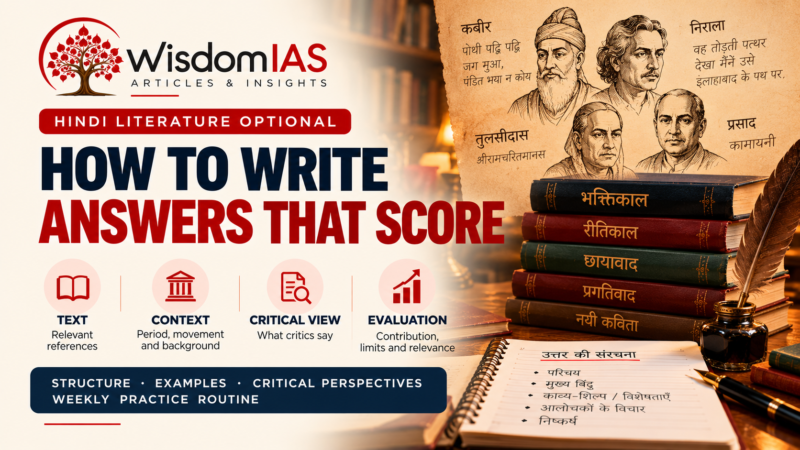
Joining a test series is easy. Getting a better score because of it is the hard part. Many aspirants write every test, look at the marks, feel good or bad for a day, and move on. A year later their writing is almost the same. A test series is a tool, and like any tool it works only when you use it with a method.
This guide shows how to prepare for a test, how to write it under exam conditions, how to read your evaluated copy, and how to convert every test into a specific improvement. (Test patterns and marking differ across UPSC and State PSC exams, so always match your practice to the latest notification.)
What a test series is really for
A test series does three jobs. It forces you to complete the syllabus on a schedule, it trains you to write in exam conditions, and it gives you feedback that you cannot give yourself. Marks are only a by-product of these three. If you treat marks as the goal, you will chase easy scores. If you treat feedback as the goal, your marks will follow.
Before the test: prepare in a smart way
- Revise the announced syllabus once in a compact form, using your own short notes rather than fresh books.
- Keep a one-page cheat sheet of examples, data, committees and schemes for each theme.
- Do not wait to be “fully prepared.” A test written at 70% preparation teaches more than a test skipped for perfection.
- Fix your writing setup in advance: pen, paper type, handwriting speed and a watch.
During the test: behave as if it is the real paper
Sit at a desk, switch off your phone, and keep to the time limit strictly. Spend the first few minutes reading all the questions and marking directive words. Attempt every question. An unattempted question teaches you nothing, while an average answer teaches you exactly where you stand. If time runs short, write a compact structured answer rather than leaving it half-finished.
After the test: the four-step review
Most of the learning happens after the test, not during it. Use this review within 48 hours, while the questions are still fresh in your mind.
| Step | Question to ask | Action |
|---|---|---|
| 1. Read the remarks | What did the evaluator actually say? | Group comments into content, structure, presentation and time |
| 2. Compare with the model answer | Which dimensions or examples did I miss? | Add them to your notes under the right theme |
| 3. Find the pattern | Is this problem repeating across tests? | Write one line in an error log |
| 4. Rewrite | Can I write the weakest answer again, better? | Rewrite one answer in the exact time limit |
Read your marks as data, not as a verdict
One low score does not predict your result. A trend across five or six tests does. Track three numbers: your average marks, your lowest-scoring question type, and the number of questions you left incomplete. If the incomplete count drops and the average slowly rises, you are improving, even if one test felt bad.
Common mistakes with test series
- Collecting test papers and writing only a few of them.
- Writing with open notes and then comparing marks with others.
- Reading only the marks and ignoring the comments.
- Taking the next test before reviewing the last one.
- Changing strategy after every single test result.
- Avoiding the optional or essay tests because they feel difficult.
Understanding is the beginning. Practice creates performance.
WisdomIAS teaching philosophy
Choose a series that gives feedback, not just papers
When you compare test series, look beyond the number of tests. Ask how the copies are evaluated, how quickly you get them back, whether the comments are specific, and whether someone can discuss your recurring errors with you. The WisdomIAS Test Series for GS and Essay is designed around this principle: timed writing followed by detailed evaluation that points to what to fix next.