Hindi Literature is a popular optional subject among aspirants who are comfortable with the language and enjoy texts and ideas. But a good command of Hindi is not the same as a good answer. The optional is scored on how well you organise your understanding of poets, movements and criticism under timed conditions. (Check the latest UPSC syllabus for the exact list of prescribed poets, texts and topics.)
This guide explains how to structure Hindi Literature answers, how to handle poet-based and movement-based questions, and how to build a weekly practice routine.
Understand the shape of the optional
Hindi Literature consists of two papers of 250 marks each, 500 in total. Broadly, Paper I covers the history of the Hindi language and its literature along with medieval poetry, and Paper II covers modern poetry, fiction, drama, prose and criticism. Because the syllabus is text-heavy, the real challenge is not reading everything once. It is being able to recall the right point in the right structure in about the time a 10 or 15-mark answer allows.
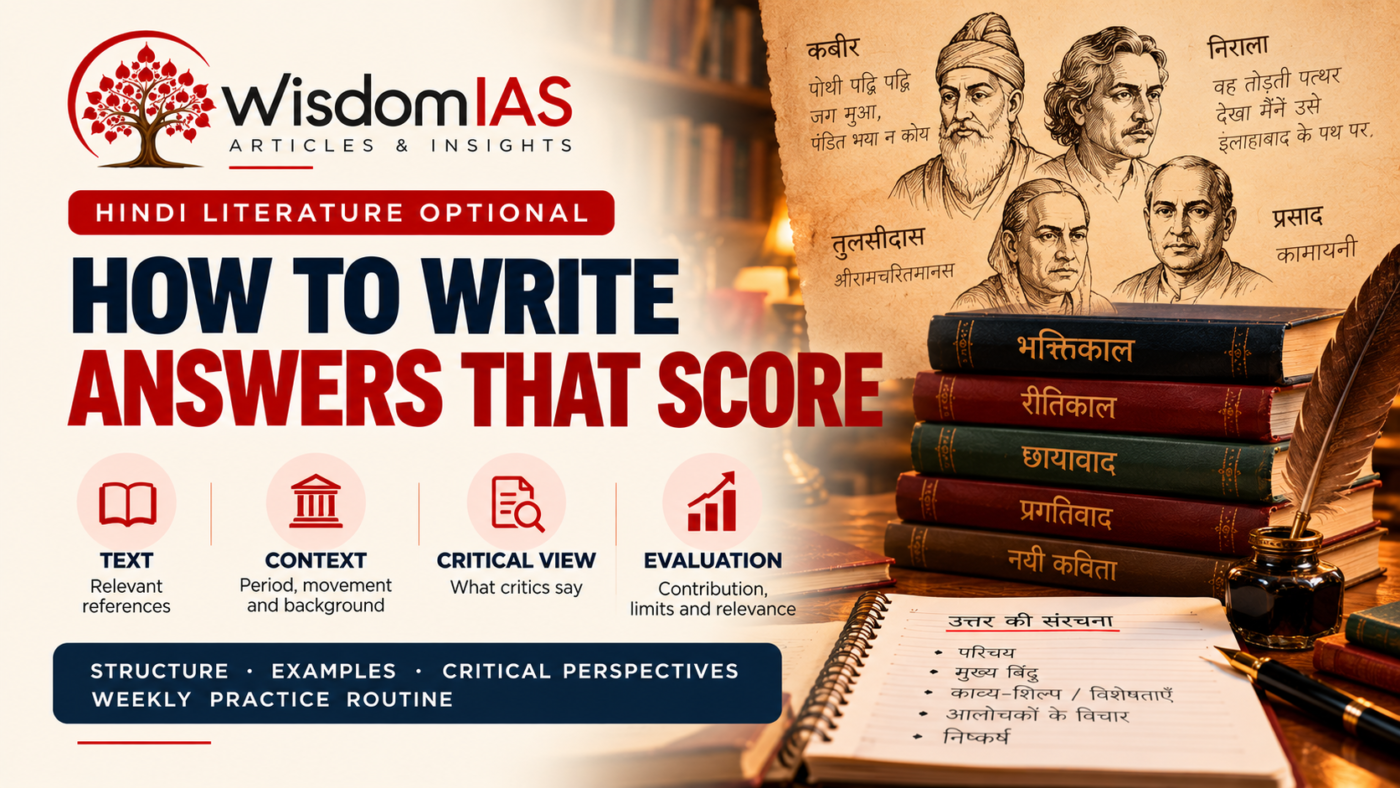
Four pillars of a high-quality answer
- Text: direct reference to the poet, work or passage, with accurate lines or incidents where they help.
- Context: the period, movement and social background in which the writing appeared.
- Critical perspective: what established critics have said, and where you agree or differ.
- Evaluation and relevance: a balanced judgement of the writer’s contribution, limits and lasting significance.
Answers that rely only on summary stay at an average level. Answers that combine text, context and critical view read as analytical.
Answering a poet-based question
Whether the question is about Kabir, Tulsidas, Surdas, Prasad, Nirala, Agyeya or Muktibodh, use a repeatable structure:
- Opening: place the poet in a tradition or movement in two lines.
- Core themes: two or three central ideas, each supported by a line or a poem.
- Craft (शिल्प): language, imagery, symbols, metre or form, wherever the question asks for it.
- Critical view: one or two critics’ observations, in your own words.
- Conclusion: the poet’s distinct contribution and relevance today.
Answering a movement-based question
Questions on movements such as छायावाद (Chhayavad), प्रगतिवाद (Pragativad), प्रयोगवाद (Prayogvad) and नयी कविता (Nayi Kavita) are common and reward comparison. Build a small table in your notes for each movement:
| Point | What to note |
|---|---|
| Background | Social, political and literary circumstances that produced it |
| Defining features | Ideas, themes, attitude to tradition, form and language |
| Representative writers | Two or three names with one signature idea each |
| Limits and criticism | Where the movement was challenged or fell short |
| Link to the next phase | How it led to, or reacted against, the following movement |
In the exam, convert that table into a flowing answer. The link to the next phase is what separates a good answer from a list.
Handling literary history questions
History questions are easy to lose marks on because aspirants either write too little or drown in dates. Use a simple timeline: period, key trends, key writers, and one distinguishing feature. A clear timeline or a short table drawn within the answer helps the examiner follow your points quickly and saves your writing time.
Writing in Hindi: clarity over decoration
- Use short, direct sentences. Heavy Sanskritised phrasing does not earn extra marks.
- Keep terminology consistent. Use the same name for the same concept throughout.
- Introduce technical terms and critics’ names correctly and use them in context.
- Pay attention to spelling, matras and paragraph breaks. Readability affects the impression of your whole script.
- Quote briefly and accurately. A misquoted line hurts more than a paraphrase.
A weekly practice routine
| Day | Focus | Output |
|---|---|---|
| Day 1 | One poet from Paper I or II | One 15-mark answer, timed |
| Day 2 | One movement or literary-history topic | One 10-mark answer with a table or timeline |
| Day 3 | One criticism or theory topic | One 10-mark answer with critics’ views |
| Day 4 | Prose, fiction or drama | One 15-mark answer, timed |
| Day 5 | Review | Rewrite the weakest answer; add lines and critics to notes |
| Weekend | Revision and a mini-test | Mixed set of 3–4 questions under exam conditions |
Always return to the original texts while revising. Notes help you recall, but lines and incidents from the texts are what make your answers specific.
Mistakes to avoid
- Writing a general biography when the question asks for analysis.
- Skipping critical perspectives because they feel difficult.
- Learning poets in isolation without linking them to movements.
- Practising only by reading, never by writing under time limits.
- Leaving answers without a conclusion because time ran out.
Understanding is the beginning. Practice creates performance.
WisdomIAS teaching philosophy
Make writing practice part of every week
Hindi Literature answers improve fastest when you write them regularly and get specific feedback on content, structure and presentation. The WisdomIAS Daily Answer Writing Practice programme includes Hindi Literature alongside GS and essay writing, with detailed evaluation of each answer.