Every serious aspirant is told to “solve previous year questions.” Very few are told how. Reading PYQs once and nodding at them is not practice. Used properly, PYQs are the best guide to what the examiner expects: the themes that return, the way questions are framed, and the depth of answer that is rewarded.
This article explains how to analyse PYQs, how to convert them into a study map, and how to practise them in a way that improves both your content and your writing.
Why PYQs matter
- They show the real scope of a syllabus topic, which is often narrower and more applied than a textbook suggests.
- They reveal the language of questions, including directive words and how multi-part questions are built.
- They help you decide what to skip, which is as valuable as knowing what to read.
- They give you a ready bank of timed practice material that matches the real exam.
Step 1: Build a theme map
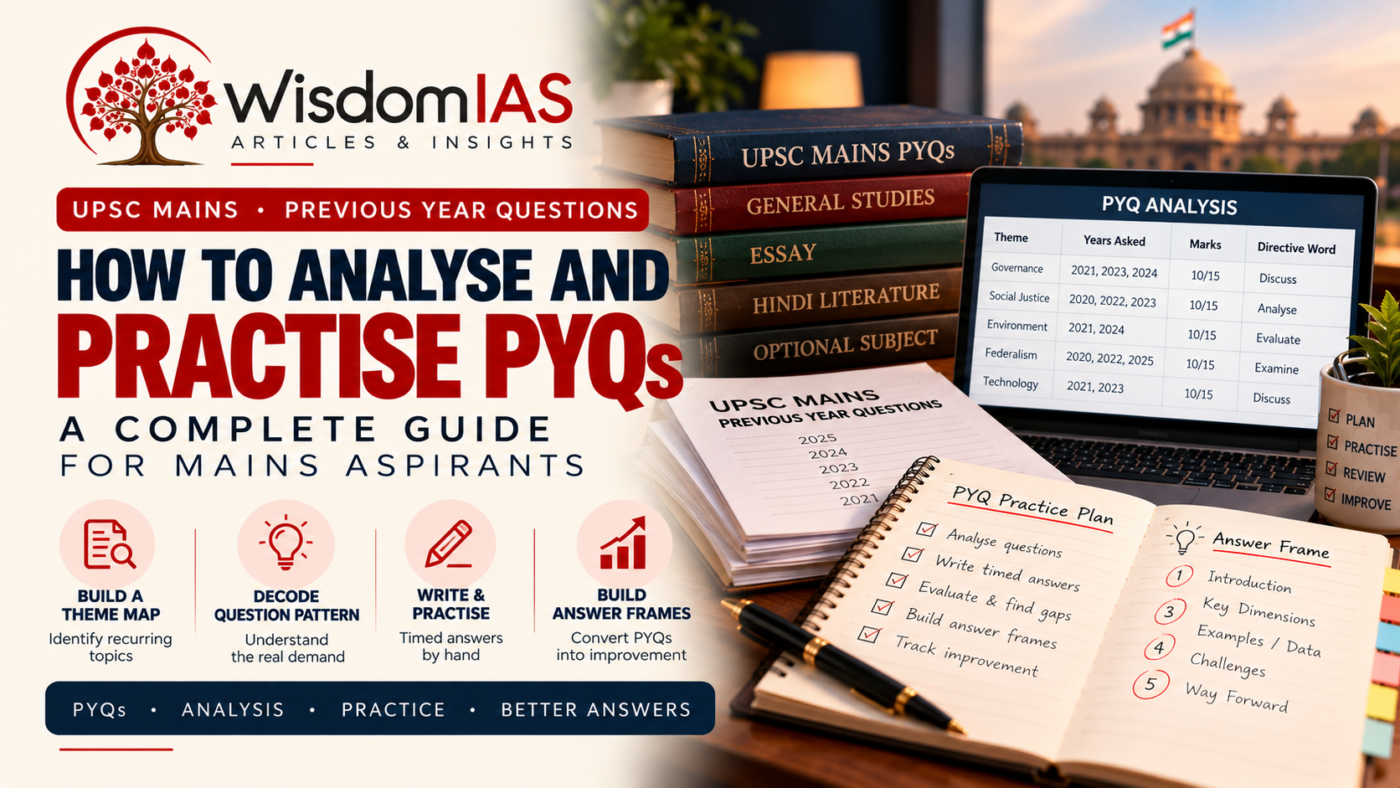
Collect questions from the last several years for one paper and sort them under the syllabus headings. Do not copy them again and again. A single sheet or a simple spreadsheet is enough. For each theme, note the year, the marks and the directive word. After a short while you will see which themes are asked almost every year and which appear only rarely.
| Theme | Years asked | Typical directive word | Nature of demand |
|---|---|---|---|
| Example: Federalism | Note the years here | Discuss / Examine | Issues plus a way forward |
| Example: Social justice | Note the years here | Analyse / Evaluate | Scheme or policy with a judgement |
The rows above are only a format. Fill the table with the actual questions of your paper.
Step 2: Decode the question pattern
For each question, ask three things. What is the core demand? Is it asking for causes, impact, evaluation or a solution? And is it a static concept linked to a current issue? You will notice that most questions combine a stable topic with a contemporary angle. That is why static notes alone are not enough, and why current affairs without static grounding stay shallow.
Step 3: Write, do not just read
Take a question, set a timer for 7 or 11 minutes depending on the marks, and write the answer by hand without opening your notes. Then compare it with your notes or a model answer. The gap you find is your real syllabus for the week. Even five PYQs written this way every week will do more for you than fifty read passively.
Step 4: Build answer skeletons
For recurring themes, prepare a short skeleton: a one-line definition, three or four dimensions, two examples, and a way-forward line. Keep it on a single page. You are not memorising a fixed answer. You are building a flexible frame that you can reshape when the question changes its wording.
Use PYQs for essay and optional too
Essay topics from earlier years show the balance between philosophical, social and contemporary themes. Write outlines for them regularly. For an optional such as Hindi Literature, previous questions show which poets, movements and critical perspectives are asked repeatedly, so your revision can give those areas more time.
Mistakes to avoid
- Predicting that a topic will not come because it was asked last year.
- Memorising model answers instead of building frames.
- Solving PYQs only after finishing the whole syllabus.
- Ignoring the directive word when comparing your answer with the model.
- Never getting your PYQ answers evaluated by someone else.
A simple weekly PYQ plan
- Two days: analyse one new set of questions and update the theme map.
- Two days: write four or five PYQs in timed conditions.
- One day: evaluate, rewrite the weakest answer and update the skeletons.
- Weekend: a short mixed test from earlier PYQs.
PYQs tell you what has been asked. Your writing practice decides whether you can answer it well. Combine the two, add regular evaluation, and your preparation becomes both focused and measurable. The WisdomIAS Daily Answer Writing Practice programme follows exactly this approach.